

Hospitals are institutions dedicated
to healing and saving lives. However, the wastewater they generate is far more
complex and potentially hazardous than that of residential or commercial
buildings. Unlike apartments, hotels, or offices, hospitals discharge a
combination of domestic sewage and biomedical effluent. Because of this dual
nature of wastewater, installing only a Sewage Treatment Plant (STP) or only an
Effluent Treatment Plant (ETP) is not technically adequate. The most
appropriate and compliant solution is an Effluent Cum Sewage Treatment
Plant (ESTP).
Understanding the Nature of Hospital
Wastewater
Hospital wastewater can broadly be
classified into two categories.
The first category is domestic
sewage, which originates from toilets, bathrooms, kitchens, laundries, and
staff facilities. This type of wastewater mainly contains organic matter,
suspended solids, oils, grease, and high Biochemical Oxygen Demand (BOD).
Conventional STPs are designed to treat this kind of wastewater effectively
through biological processes.

The second category is clinical
or biomedical effluent, which comes from operation theatres, pathology
laboratories, dialysis units, ICUs, and areas where disinfectants and chemicals
are heavily used. This wastewater may contain antibiotics, pharmaceutical
residues, pathogens, toxic chemicals, heavy metals, and disinfectants. Such
contaminants require chemical treatment and specialized handling similar to
what an ETP provides.
Why Only STP Is Not Sufficient
A Sewage Treatment Plant is
primarily designed to reduce organic load through biological treatment. While
it efficiently removes BOD, COD, and suspended solids, it is not engineered to
neutralize toxic chemicals, drug residues, or antibiotic compounds commonly
present in hospital effluent. Discharging partially treated hospital wastewater
can lead to environmental contamination, spread of antibiotic resistance, and
non-compliance with regulatory standards. Therefore, relying solely on an STP
for hospital wastewater treatment poses both environmental and legal risks.
Why Only ETP Is Not Economical
On the other hand, an Effluent
Treatment Plant focuses on chemical neutralization, pH correction, and removal
of toxic substances. However, in most hospitals, nearly 70–80% of the total
wastewater is domestic in nature. Treating all wastewater as industrial
effluent increases chemical consumption, energy usage, sludge generation, and
overall operating costs. This makes an ETP-only approach economically
inefficient and unnecessarily complex.
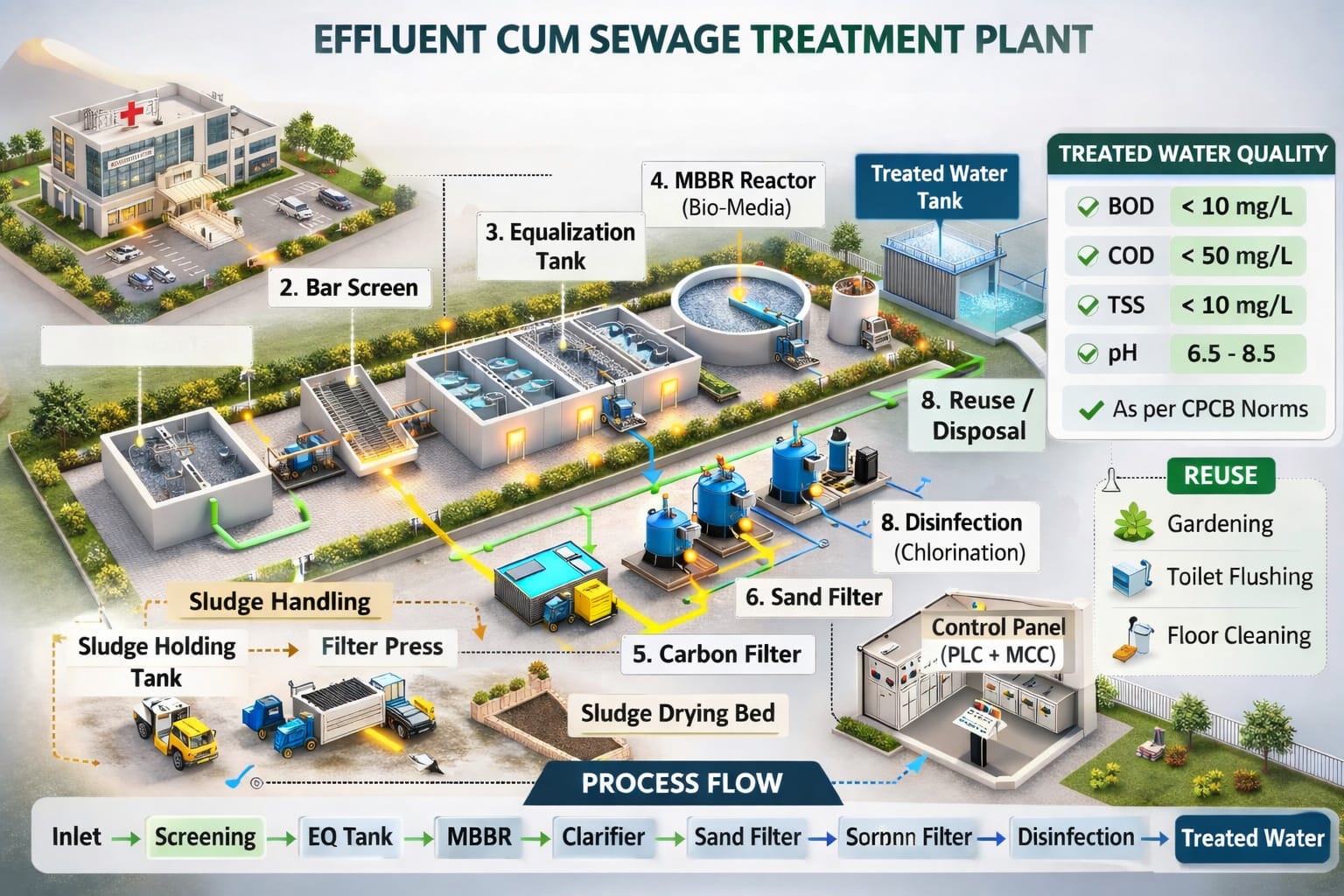
The Integrated Solution: ESTP
An Effluent Cum Sewage Treatment
Plant (ESTP) integrates the strengths of both STP and ETP systems. It combines
equalization, chemical treatment (where required), biological treatment,
clarification, advanced filtration, and proper disinfection within a single,
optimized system.
Regulatory Compliance and Environmental
Responsibility
In India, hospitals must comply with
discharge standards prescribed by the
Central Pollution Control Board (CPCB)
and respective State Pollution Control Boards. Proper treatment of hospital
effluent is also aligned with Biomedical Waste Management regulations. An ESTP
ensures compliance, safeguards public health, and promotes sustainable water
reuse for gardening, flushing, or cooling applications.
Conclusion
Hospitals generate a unique mixture
of domestic sewage and hazardous biomedical effluent. Installing only an STP or
only an ETP does not address the complete treatment requirement. An
integrated Effluent Cum Sewage Treatment Plant (ESTP) offers
the technically sound, cost-effective, and environmentally responsible solution
for modern healthcare facilities.
Read Comments